Intelligent agents that can adapt, and whose behavior is interpretable.

The core of our work is foundational: we develop algorithms for building intelligent agents that act well under uncertainty and adapt as their environment changes, and we develop methods for interpreting what those agents are doing and why. The projects below carry that agenda into specific domains (emergency response, public health, and mobility) where the algorithms have to survive contact with systems people depend on.

Foundations

Multi-Agent Decision-Making under Non-Stationarity

Almost every deployed decision system assumes the world it was trained on is the world it will act in. It is not. Traffic patterns shift, demand moves, infrastructure degrades, and other agents change how they behave. We design agents that detect when the dynamics of their environment have changed and adapt online, through learned temporal abstraction, policy-augmented search, and belief representations that stay tractable when the state is only partially observed. We also built and released NS-Gym, the first open benchmark suite for non-stationary Markov decision processes, so that claims in this area can actually be compared.
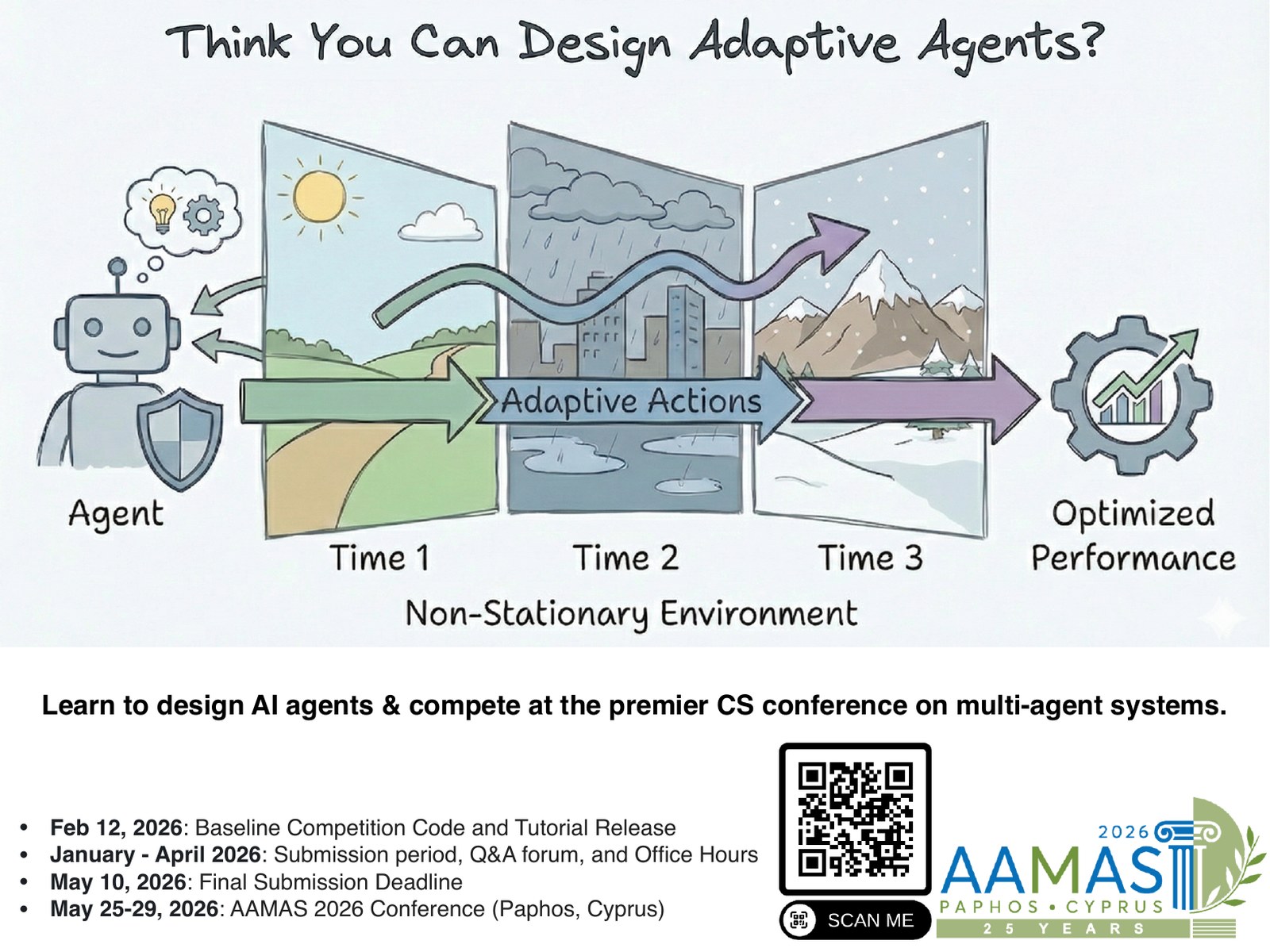
AAMAS 2026 competition
AAMAS 2026 competitionThink you can design adaptive agents? Our competition on decision-making in non-stationary environments, at AAMAS 2026 in Paphos.Poster, PDF
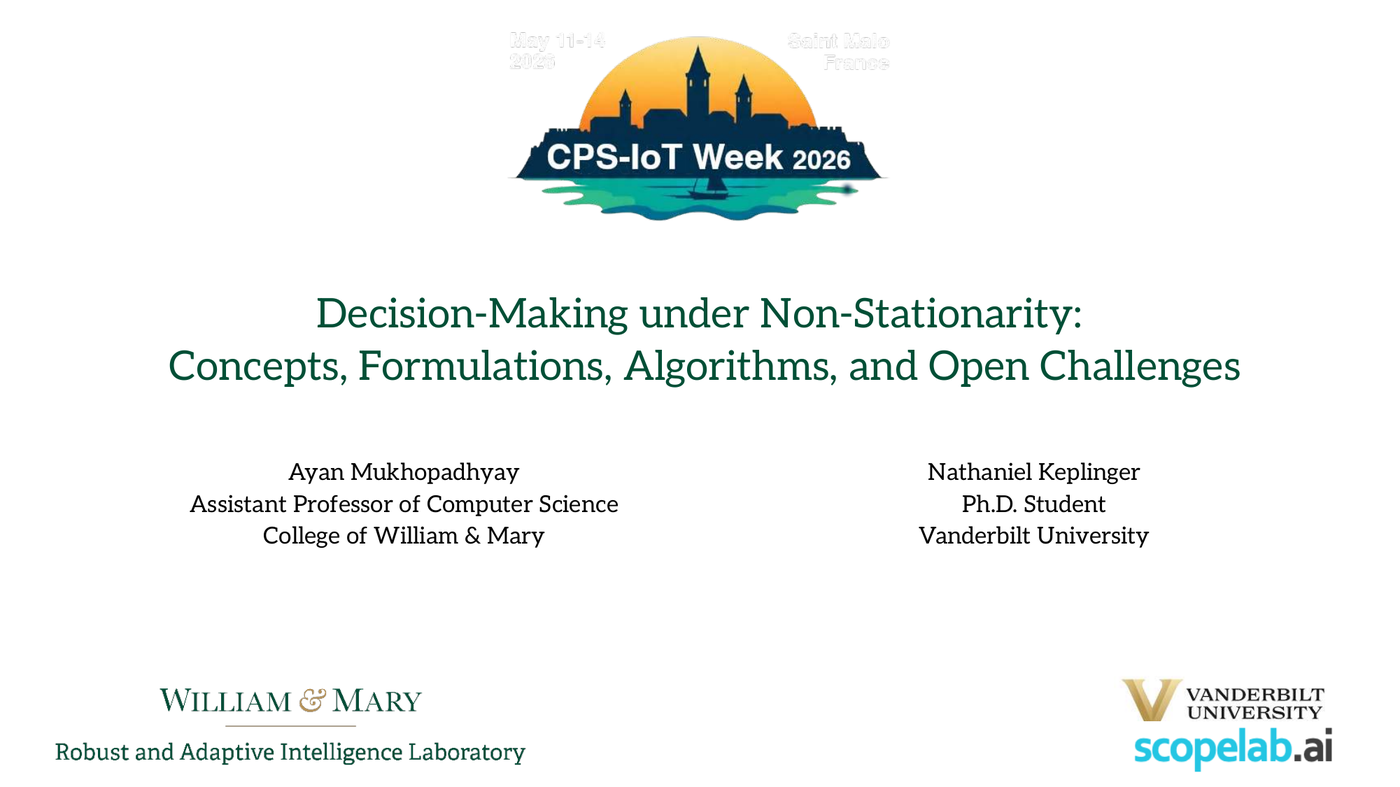
Decision-making under non-stationarity
Decision-making under non-stationarityTutorial slides: concepts, formulations, algorithms, and open challenges.42 slides, PDF, 2.2 MB
Funding · NSF (Co-PI) · DARPA (Investigator)  ·  Code · NS-Gym
  • Non-stationary MDPs
  • POMDPs
  • Monte Carlo tree search
  • Multi-agent RL
  • ICLR 2025 Spotlight
Key papers5
  • ESCORT: Efficient Stein-variational and Sliced Consistency-Optimized Temporal Belief Representation for POMDPs Yunuo Zhang, Baiting Luo, Ayan Mukhopadhyay, Gabor Karsai, Abhishek Dubey Conference on Neural Information Processing Systems (NeurIPS 2025) · 24% acceptance
  • NS-Gym: Open-Source Simulation Environments and Benchmarks for Non-Stationary Markov Decision Processes Nathaniel S. Keplinger, Baiting Luo, Yunuo Zhang, Kyle Hollins Wray, Aron Laszka, Abhishek Dubey, Ayan Mukhopadhyay Conference on Neural Information Processing Systems (NeurIPS 2025) · 24% acceptance
  • Scalable Decision-Making in Stochastic Environments through Learned Temporal Abstraction Spotlight Baiting Luo, Ava Pettet, Aron Laszka, Abhishek Dubey, Ayan Mukhopadhyay International Conference on Learning Representations (ICLR 2025) · 5.1% acceptance
  • Act as You Learn: Adaptive Decision-Making in Non-Stationary Markov Decision Processes Baiting Luo, Yunuo Zhang, Abhishek Dubey, Ayan Mukhopadhyay International Conference on Autonomous Agents and Multiagent Systems (AAMAS 2024) · 25% acceptance
  • Decision Making in Non-Stationary Environments with Policy-Augmented Search Ava Pettet, Yunuo Zhang, Baiting Luo, Kyle Wray, Hendrik Baier, Aron Laszka, Abhishek Dubey, Ayan Mukhopadhyay International Conference on Autonomous Agents and Multiagent Systems (AAMAS 2024) · 25% acceptance

The full list is on the publications page.

With support from NSF DARPA
Top

Societal-scale systems

Planning for Critical Societal Cyber-Physical Systems

Some systems cannot be allowed to fail, and the agents inside them have to coordinate in real time under partial information. Emergency response is the sharpest case: where should ambulances and fire engines wait, and which one should be sent when a call comes in? We treat urban incident response as a single stochastic control problem rather than a sequence of independent dispatch choices, forecasting where incidents are likely to occur from sparse historical data, stationing responders proactively across a city, and dispatching under policies that hold up when demand spikes or a station goes offline. The same framing carries into the built environment through our work on vehicle-to-building integration, where fleets of electric vehicles, building loads, and the grid all act on one another: each vehicle negotiates when and how much to charge, and every such decision reshapes the problem the others are solving. Both settings run with real partners, and the resulting tools are open source.

Multi-Agent Systems for Emergency ResponseTutorial at the IEEE Conference on Smart Computing.
Funding · NSF (Co-PI) · Tennessee DOT (Co-PI) · Nissan North America (Co-PI)  ·  Code · StatResp · RESPOND
  • Incident prediction
  • Proactive stationing
  • Hierarchical planning
  • Vehicle-to-building
  • Deployed system
Key papers5
  • Multi-Agent Reinforcement Learning with Hierarchical Coordination for Emergency Responder Stationing Amutheezan Sivagnanam, Ava Pettet, Hunter Lee, Ayan Mukhopadhyay, Abhishek Dubey, Aron Laszka International Conference on Machine Learning (ICML 2024) · 27.5% acceptance
  • A Review of Emergency Incident Prediction, Resource Allocation and Dispatch Models Ayan Mukhopadhyay, Geoffrey Pettet, Sayyed Vazirizade, Di Lu, Said El Said, Alex Jaimes, Hiba Baroud, Yevgeniy Vorobeychik, Mykel Kochenderfer, Abhishek Dubey Elsevier Journal of Accident Analysis and Prevention
  • Hierarchical Planning for Resource Allocation in Emergency Response Systems TCPS Special Issue Invite Geoffrey Pettet, Ayan Mukhopadhyay, Mykel Kochenderfer, Abhishek Dubey ACM/IEEE Conference on Cyber-Physical Systems (ICCPS 2021) · 28% acceptance
  • Robust Spatio-Temporal Incident Prediction Ayan Mukhopadhyay, Kai Wang, Andrew Perrault, Mykel Kochenderfer, Milind Tambe, Yevgeniy Vorobeychik Conference on Uncertainty in Artificial Intelligence (UAI 2020) · 27% acceptance
  • An Online Decision-Theoretic Framework for Responder Dispatch Ayan Mukhopadhyay, Geoffrey Pettet, Chinmaya Samal, Abhishek Dubey, Yevgeniy Vorobeychik ACM/IEEE Conference on Cyber-Physical Systems (ICCPS 2019) · 23% acceptance

The full list is on the publications page.

With support from NSF Tennessee DOT
Top

Mobility

Smart and Efficient Routing for Urban Transportation

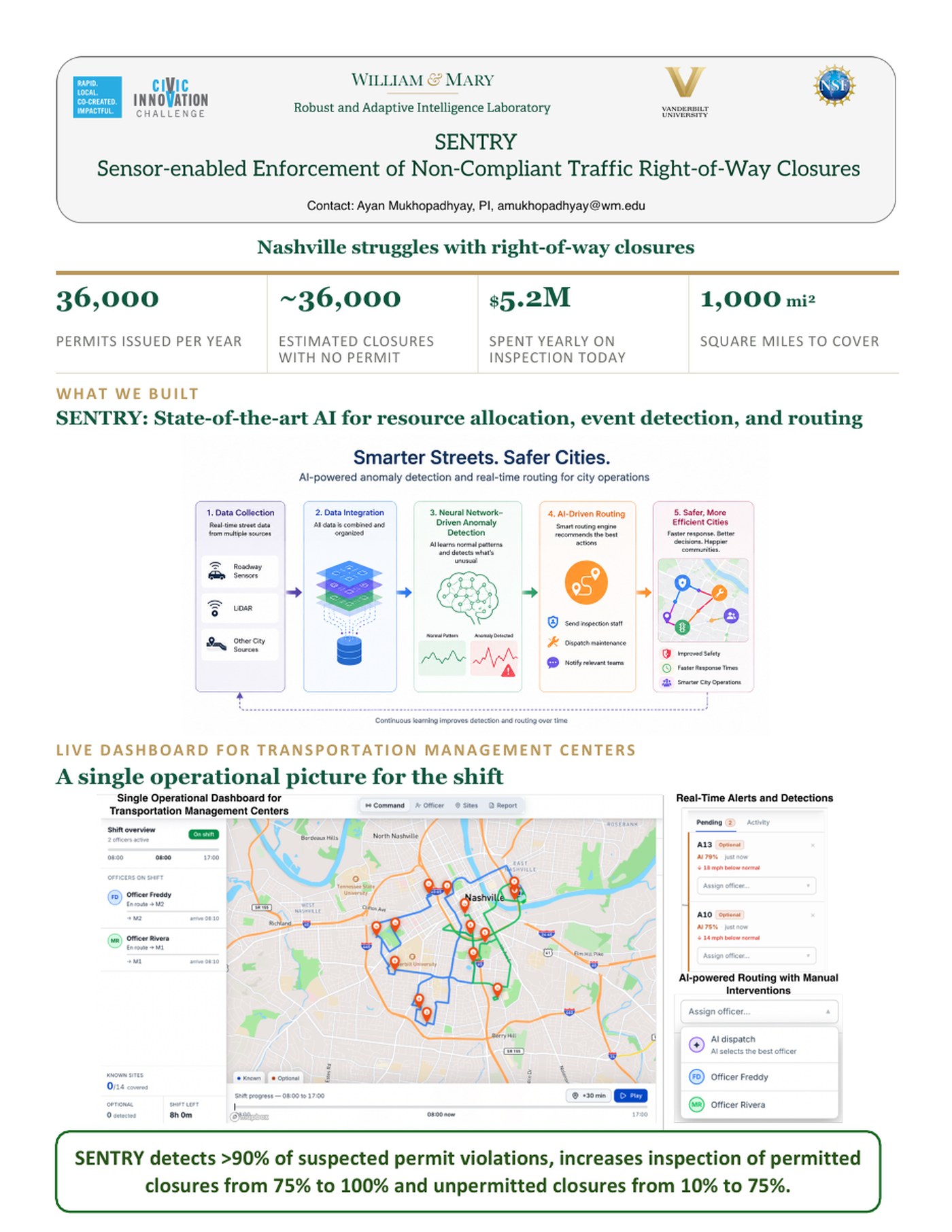
Most mobility systems are built as two disconnected halves: a model that predicts demand, and a solver that routes vehicles. We work on the seam between them, training predictors against the decisions they will feed rather than against forecast error alone. The problems come from operating partners: the Chattanooga Area Regional Transportation Authority, Nashville WeGo, and city governments through our NSF CIVIC project on data-driven monitoring of right-of-way permits. The work spans paratransit and microtransit routing, bus stationing and dispatch, school-bus disruption management, and real-time energy consumption for mixed fleets of electric, hybrid, and diesel vehicles. This line of research also led to the founding of MobiusAI, of which I am a co-founder, building the future of AI-driven transit.

Smart transit in ChattanoogaOur work with transit agencies on paratransit, routing, and demand.
SENTRY
SENTRYSensor-enabled enforcement of non-compliant traffic right-of-way closures, our NSF CIVIC project with the city of Nashville.Poster, PDFExplore the SENTRY project site →
Funding · NSF CIVIC (PI) · U.S. DOE (Co-PI) · U.S. DOT (Co-PI) · TNGo (Co-PI)
  • Predict-then-optimize
  • Vehicle routing
  • Multi-task learning
  • Energy forecasting
  • ICCPS 2024 Best Paper
  • SMARTCOMP 2026 Best Paper
Key papers5
  • Dynamic Pickup-and-Delivery Routing with Early-Arrival Waiting Limits and Station Relocation Best Paper Award A. Khanna, S. Pavia, F. Liu, Ayan Mukhopadhyay, A. Dubey IEEE International Conference on Smart Computing (SMARTCOMP 2026)
  • An End-to-End Solution for Public Transit Stationing and Dispatch Problem J. P. Talusan, Chaeeun Han, David Rogers, Ayan Mukhopadhyay, Aron Laszka, Dan Freudberg, Abhishek Dubey ACM Transactions on Cyber-Physical Systems (TCPS)
  • Deploying Mobility-On-Demand for All by Optimizing Paratransit Services Sophie Pavia, David Rogers, Amutheezan Sivagnanam, Michael Wilbur, Danushka Edirimanna, Youngseo Kim, Philip Pugliese, Samitha Samaranayake, Aron Laszka, Ayan Mukhopadhyay, Abhishek Dubey International Joint Conference on Artificial Intelligence (IJCAI 2024) · 20% acceptance
  • An Online Approach to Solving Public Transit Stationing and Dispatch Problem Best Paper Award Jose Paolo Talusan, Chaeeun Han, Ayan Mukhopadhyay, Aron Laszka, Dan Freudberg, Abhishek Dubey International Conference on Cyber-Physical Systems (ICCPS 2024) · 28.2% acceptance
  • Energy and Emission Prediction for Mixed-Vehicle Transit Fleets Using Multi-Task and Inductive Transfer Learning Michael Wilbur, Ayan Mukhopadhyay, Sayyed Vazirizade, Philip Pugliese, Aron Laszka, Abhishek Dubey European Conference on Machine Learning (ECML 2021) · 25% acceptance

The full list is on the publications page.

With support from NSF U.S. Department of Energy U.S. Department of Transportation
Top

Interpretability

Interpretable Planning

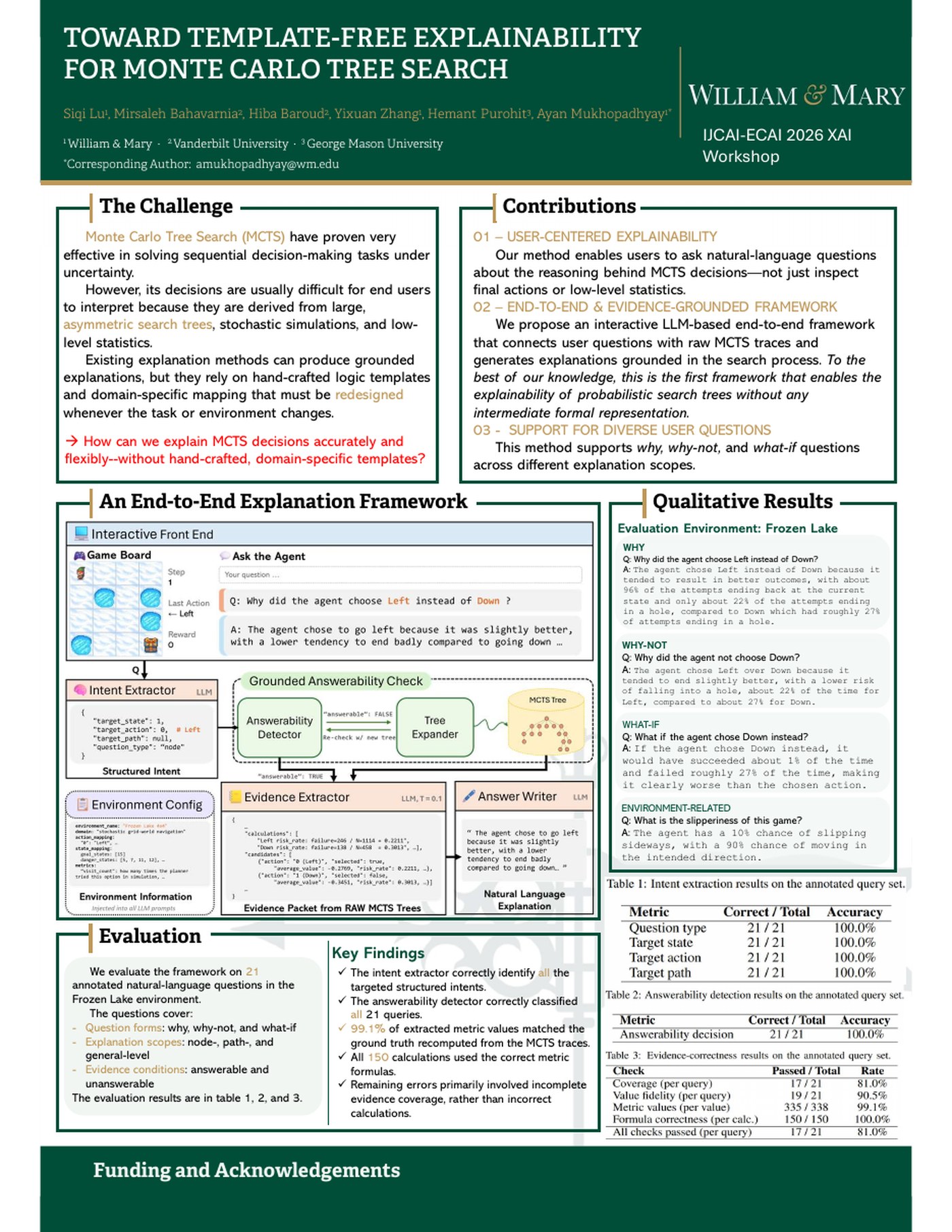
As planners come to rely on opaque neural components, a practical question gets harder: why was this action chosen, and what would have had to be different for the system to choose another? We build explanations from the structure of the search itself: computation tree logic over Monte Carlo tree search, and language models constrained by formal specifications rather than left to narrate freely. The goal is an explanation an operator can interrogate and, when it is wrong, contradict.

Toward template-free explainability for Monte Carlo tree search
Toward template-free explainability for Monte Carlo tree searchLed by Siqi Lu, with Vanderbilt and George Mason. IJCAI-ECAI 2026 XAI Workshop.Poster, PDF
Funding · NSF (Co-PI) Related · LogiEx · Patent pending on integrating formal logic and LLMs for explainable planning
  • Explainable planning
  • Formal logic
  • Computation tree logic
  • LLMs for planning
Key papers4
  • LogiEx: Logic-Integrated Explanations for Stochastic Planning in Cyber-Physical Systems Z. An, X. Wang, H. Baier, Z. Chen, A. Dubey, Ayan Mukhopadhyay, T. T. Johnson, J. Sprinkle, M. Ma ACM/IEEE International Conference on Cyber-Physical Systems (ICCPS 2026) · 28% acceptance
  • Formal Logic-Guided Harnessing of Heterogeneous Fairness Rules in Smart Cities Ziyan An, Yiqi Zhao, Xuqing Gao, Ayan Mukhopadhyay, Meiyi Ma ACM Transactions on Cyber-Physical Systems (TCPS)
  • Combining LLMs with Logic-Based Framework to Explain MCTS Ziyan An, Xia Wang, Hendrik Baier, Zirong Chen, Abhishek Dubey, Taylor T. Johnson, Jonathan Sprinkle, Ayan Mukhopadhyay, Meiyi Ma AAMAS 2025 (Extended Abstract)
  • Enabling MCTS Explainability for Sequential Planning Through Computation Tree Logic Ziyan An, Hendrik Baier, Abhishek Dubey, Ayan Mukhopadhyay, Meiyi Ma European Conference on Artificial Intelligence (ECAI 2024) · 23% acceptance

The full list is on the publications page.

With support from NSF
Top

Public health

Decision-Making for Public Health: ADVISER

Built with HelpMum, a Nigerian non-profit, and supported by Google AI for Social Good. ADVISER pairs machine-learning models that forecast immunization outcomes with algorithms for solving large-scale mathematical programs over scarce intervention resources: deciding where to send outreach workers, which clinics to stock, and when. It is deployed across thirteen local governments in Nigeria and has improved immunization outcomes by over 30%.

Funding · Google AI for Social Good (PI) · Patrick J. McGovern Foundation (Co-PI)
  • Combinatorial optimization
  • Demand forecasting
  • Deployed system
  • IJCAI 2022 Best Paper
  • AAAI 2024 Oral
Key papers2
  • Deploying ADVISER: Impact and Lessons from Using Artificial Intelligence for Child Vaccination Uptake in Nigeria Oral Kehinde Opadele, Abdul Ruth, Afolabi Bose, Vir Parminder, Namblard Corinne, Ayan Mukhopadhyay, Abiodun Adereni AAAI Conference on Artificial Intelligence (AAAI 2024) · 6.2% acceptance
  • ADVISER: AI-Driven Vaccination Intervention Optimiser for Increasing Vaccine Uptake in Nigeria Best Paper Award Vineet Nair, Kritika Prakash, Michael Wilbur, Aparna Taneja, Corrine Namblard, Oyindamola Adeyemo, Abhishek Dubey, Abiodun Adereni, Milind Tambe, Ayan Mukhopadhyay International Joint Conference on Artificial Intelligence (IJCAI 2022) · 15% acceptance

The full list is on the publications page.

With support from Google Patrick J. McGovern Foundation
Top

Interested in working on these problems?

We recruit PhD students, and William & Mary undergraduates and master's students are welcome to get involved in research.